Xero Reports Look Fine. So Why Is There Still No Cash?
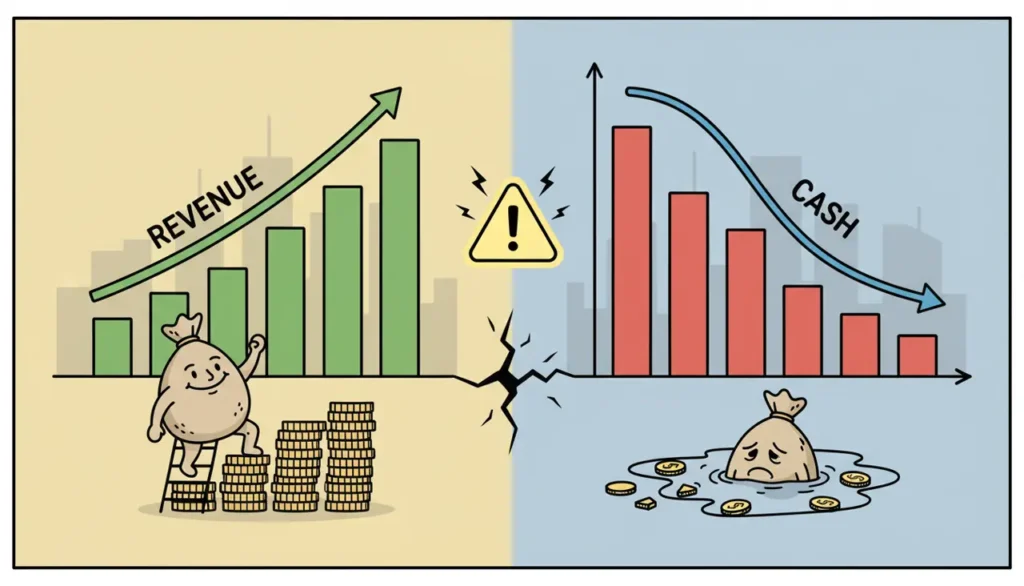
Xero reports but no cash is one of the most frustrating situations for a business owner.
The profit and loss report may show a profit. Sales may be increasing. The bank account may even look comfortable for a few days.
Then payroll, supplier payments, GST or another busy week arrives, and cash suddenly feels tight again.
Why Xero Can Show Profit While Cash Still Feels Tight
This does not always mean the Xero report is wrong.
The report and the bank balance are showing different parts of the business.
The profit and loss report shows income and expenses for a period. The bank balance shows the cash that has actually moved in and out.
Unpaid invoices, stock purchases, loan repayments and owner withdrawals can create a large gap between reported profit and available cash.
1. Customer Invoices Have Not Been Collected
Revenue may appear in the profit and loss report when the business raises an invoice.
But the related cash does not reach the bank until the customer pays.
If customers take longer than expected, the business may show profit while struggling to cover current commitments.
Review:
- Total outstanding invoices.
- Overdue invoices.
- Customers who regularly pay late.
- Whether invoices are sent promptly.
- Whether collection follow-up has a clear owner.
2. Cash Has Been Used To Buy Stock Or Deliver Work
A business may need to pay for stock, ingredients, materials or subcontractors before the related customer revenue is collected.
The cost may eventually support profitable sales, but the cash leaves first.
This is common in retail, food and beverage, construction, project work, manufacturing and businesses using subcontractors.
Growing sales can make this pressure worse if the business must purchase more stock or fund larger jobs in advance.
The business may therefore become busier and more profitable on paper while requiring more working cash.
3. Supplier And Customer Timing Do Not Match
Cash pressure often comes from a timing mismatch.
For example:
- Customers pay in 45 days.
- Suppliers require payment in 14 days.
- Payroll must be paid monthly.
- GST and other obligations have fixed due dates.
The business may earn enough overall but still lack cash when payments become due.
This is why cash planning should consider dates, not only totals.
4. Operating Expenses Have Grown Quietly
Sales may be increasing, but operating expenses may be growing just as quickly.
Common examples include additional employees, software subscriptions, marketing commitments, office or outlet costs, professional fees and administrative support.
Each new expense may appear reasonable. Together, they can consume the improvement created by higher sales.
The owner should review whether the amount remaining after direct delivery costs is still enough to support current overhead and profit.
5. Profit Has Been Used For Other Cash Commitments
Reported profit does not tell you where every dollar of cash went.
Cash may have been used for items that do not appear as an ordinary expense in the profit and loss report, including:
- Loan principal repayments.
- Equipment purchases.
- Deposits.
- Director or shareholder withdrawals.
- Repayment of related-party balances.
- Changes in working capital.
These movements may reduce the bank balance without reducing accounting profit by the same amount.
6. Tax And GST Cash Has Not Been Planned Separately
Some cash received by the business may need to be retained for future tax or GST payments.
When that cash remains in the main bank account, it can look available for ordinary spending.
The pressure appears later when the payment becomes due.
Upcoming statutory commitments should be reviewed as part of the wider cash position rather than only when the deadline approaches.
7. The Records May Not Be Current Enough
Sometimes the problem is not the difference between profit and cash. It is that the report is incomplete.
The profit figure may be overstated when:
- Supplier bills have not been entered.
- Bank transactions remain unreconciled.
- Payroll entries are missing.
- Inventory or project costs are incomplete.
- Expenses were recorded in the wrong period.
- Refunds or credit notes were not processed.
Before relying on the report, confirm that the records are current enough to support the decision.
What To Review When Cash Feels Tight
Do not respond immediately by chasing more sales or cancelling every expense.
Start by identifying the main source of the pressure.
Check Collections
- Which customer invoices are overdue?
- Which large invoices are expected soon?
- Are invoices being raised without delay?
Check Upcoming Payments
- What must be paid before the next major collection?
- When are payroll, GST, tax and loan payments due?
- Which supplier payments are essential?
Check Spending
- Which operating expenses increased?
- Was the increase planned?
- Is one recurring commitment creating pressure?
Check Report Reliability
- Are bank accounts reconciled?
- Have supplier bills and payroll been entered?
- Are unusual balances being investigated?
Use Monthly Money Day To Review The Wider Position
Cash control does not require the owner to stare at the bank account every day.
Operational tasks such as invoicing, bill entry, collection follow-up and reconciliation should happen throughout the month.
The owner can then use monthly Money Day to review the wider position.
Useful questions include:
- Did the bank position improve or weaken?
- Which overdue invoices need action?
- What major payments are coming next?
- Which one issue needs attention next month?
The aim is not to solve every problem in one meeting.
It is to identify whether the main pressure sits in Cash, Profit or Revenue and choose one practical next step.
How Xero Can Help
Xero can make cash pressure easier to understand when the records are maintained consistently.
Useful areas include:
- Bank feeds and reconciliation.
- Outstanding invoice reports.
- Outstanding bill reports.
- Profit and loss reporting.
- Balance-sheet accounts.
- Bank Summary and cash-related reports.
But Xero does not make the business decision automatically.
The owner still needs to connect the reports with collection timing, upcoming commitments, spending and the actual bank position.
Common Questions About Xero Reports But No Cash
Does reported profit mean the same amount should be in the bank?
What should I check first when cash suddenly feels tight?
Should I review the bank balance every day?
Can more sales solve the cash problem?
Why does the profit and loss report look healthy while cash keeps falling?
Does this mean my Xero setup is wrong?
The Takeaway
When you see Xero reports but no cash, do not assume the profit disappeared mysteriously.
Find out whether cash is:
- Waiting to be collected.
- Tied up in stock or work.
- Needed for upcoming payments.
- Being consumed by rising overhead.
- Used for loans, assets or withdrawals.
- Hidden by incomplete records.
The numbers should help you identify the pressure before another difficult month arrives.
Related reads
Does Xero Show Profit While Your Bank Still Feels Tight?
Use the CPR Compass to check whether the pressure comes mainly from Cash, Profit or Revenue, or book a Xero demo to review how your records support business decisions.
Check My CPR Gap Book A Xero Demo