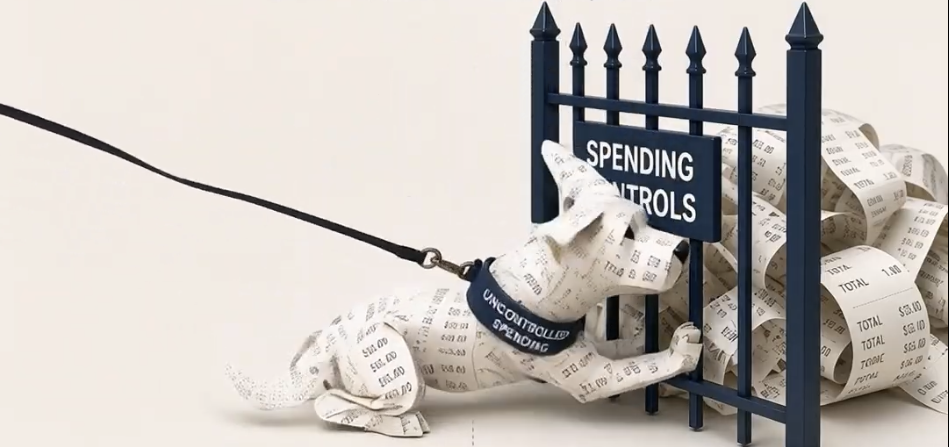
Most businesses do not lose profit because of one huge expense. Good spending controls help stop profit disappearing one small decision at a time.
Think about that dog at the gate.
It keeps pushing because it wants to get through. And if the gate is weak, eventually it will.
Expenses can behave the same way. Another subscription. Another discount. Another purchase because “it’s only a small amount.”
Say yes often enough and those small expenses start deciding where your profit goes.
It’s easier to lock the gate than chase the dog.
Set the spending limit before the expense gets through.
Why spending controls matter for small expenses
Most business owners are quite careful when the number is big.
A new vehicle, a renovation or a major hire usually gets discussed properly. You look at the numbers. You think about it. You ask whether it makes sense.
The smaller expenses are the ones that quietly slip through.
- Another software subscription.
- A discount to close the sale.
- An urgent purchase someone says they need today.
- A service nobody has reviewed for months.
- A recurring cost that started small and slowly grew.
One by one, they may not look like much. Add them together every month and suddenly you are wondering where the profit went.
The bank balance can fool you
This is another trap I see quite often.
There is money in the bank, so it feels like the business can afford to spend it. But some of that cash may already belong to GST, payroll, suppliers, tax or other commitments.
So I would not just ask: “Do we have enough money in the bank?”
I would ask: “After everything we need to pay, is this amount actually safe to spend?”
Cash in the bank does not mean cash available to spend
Your bank balance tells you how much cash is sitting there today. It does not tell you how much is still available after upcoming bills, commitments and the profit you want to protect.
Spending controls do not mean stop spending
I am not saying cut every expense.
A business still needs to spend on people, systems, marketing and growth. Some expenses are exactly what help you make more money.
The point is to stop saying yes automatically.
Decide the boundary first. Then when a new expense comes along, you already know whether it fits.

Set the limit
Decide what the business can safely spend before new expenses start appearing.
Question new spending
Ask what you are getting back. Does it protect revenue, save time or improve profit?
Review recurring costs
Pay attention to the small monthly costs. They are small once, but they repeat every month.
Before you say yes, ask these 3 questions
Before approving a new expense, I would ask:
- Do we really need it?
- What result should this expense produce?
- Does it fit within what we can safely spend?
If you cannot answer those clearly, you probably do not need to say yes immediately.
Small yeses become big expenses.
Don’t wait to see what profit is left
A lot of SME owners do it the other way round.
Revenue comes in. Expenses get paid. Then at the end of the month, they look at what is left and call that profit.
By then, the money has already gone.
I prefer to decide what we want to protect first. Then work out what the business can safely spend around that.
That is what the gate is doing. It is not stopping the business from moving forward. It is stopping uncontrolled spending from deciding where all the money goes.
That is the purpose of good spending controls: set the boundary before the money leaves the business.
Set the limit. Protect the profit. Then spend what is actually safe to spend.
Not sure what your business can safely spend?
Use the CFOSg Safe-to-Spend tool to get a clearer view of how much cash is actually available for operating expenses.
Check my Safe-to-Spend