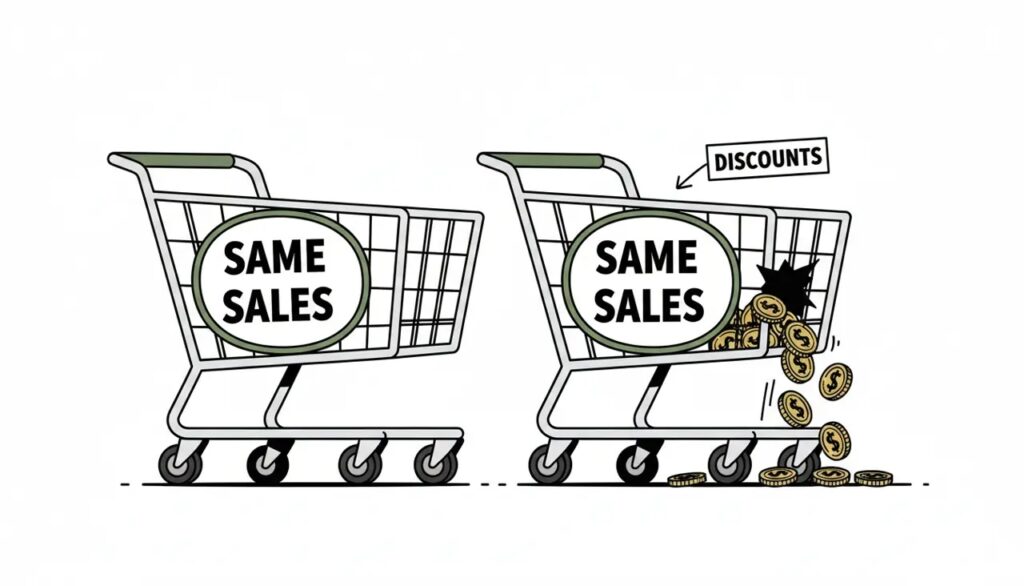
When A Small Discount Destroys Big Profit
A 10 percent discount profit drop can be much larger than the discount itself.
The customer sees a modest price reduction. The owner may see it as a quick way to close the sale. But if materials, subcontractors, payroll and operating expenses do not fall, the discount is often absorbed by profit.
This is why a business can increase activity, serve more customers and still finish the month with less money left.
Why A 10% Discount Can Hurt More Than Expected
Many owners think about a discount as a percentage of sales.
But profit is usually only a smaller part of each sale. When the price falls and the costs remain, the discount comes out of that smaller profit portion.
Common thoughts before discounting include:
- “It is only 10%.”
- “We will recover it through volume.”
- “At least the team stays busy.”
- “We cannot afford to lose this customer.”
- “There is still some margin left.”
Each statement may sound reasonable. But the result depends on whether the additional work produces enough money after delivery costs and overhead.
A Simple Business Example
Jason runs a small workshop generating $100,000 in sales during a period.
Before any discount, the financial position looks like this:
| Area | Amount | Percentage Of Sales |
|---|---|---|
| Sales | $100,000 | 100% |
| Materials | ($35,000) | 35% |
| Subcontractors | ($10,000) | 10% |
| Operating expenses | ($40,000) | 40% |
| Profit | $15,000 | 15% |
The business earns $15,000 of profit from $100,000 of sales.
That may look like enough room to offer a small discount. But the profit cushion is only $15,000.
A $10,000 reduction in selling price is therefore not small compared with the amount the business currently keeps.
Look At What Remains After Direct Costs
Materials and subcontractors are required to deliver the work. That money is not freely available to pay rent, payroll, administration or profit.
| Area | Amount | What It Means |
|---|---|---|
| Sales | $100,000 | Total amount charged |
| Direct delivery costs | ($45,000) | Materials and subcontractors |
| Amount remaining before overhead | $55,000 | Available to support operating expenses and profit |
| Operating expenses | ($40,000) | Rent, payroll, administration and other overhead |
| Profit | $15,000 | Amount left after costs |
This remaining amount is related to what CFOSg calls Spendable Revenue: a clearer view of the money available to support the wider business after direct delivery commitments are considered.
10 Percent Discount Profit Drop: The Per-Dollar View
Before the discount, each dollar of sales is supporting:
| From Every $1 Of Sales | Where It Goes |
|---|---|
| $0.45 | Materials and subcontractors |
| $0.40 | Operating expenses |
| $0.15 | Profit |
The profit portion is only 15 cents from each dollar of sales.
A 10-cent price reduction is therefore large compared with the 15 cents the business originally expected to keep.
This is the main reason profit may fall much faster than sales.
What Happens After The 10% Discount?
Assume Jason completes the same amount of work but charges customers 10% less.
Sales fall from $100,000 to $90,000. Materials, subcontractors and operating expenses remain unchanged because the same jobs are still being delivered.
| Area | Before Discount | After 10% Discount |
|---|---|---|
| Sales | $100,000 | $90,000 |
| Materials and subcontractors | ($45,000) | ($45,000) |
| Amount remaining before overhead | $55,000 | $45,000 |
| Operating expenses | ($40,000) | ($40,000) |
| Profit | $15,000 | $5,000 |
Sales fall by 10%, but profit falls from $15,000 to $5,000.
That is a reduction of about two-thirds of the original profit.
The example is simplified, but it shows the core risk clearly: when the same work is delivered at a lower price, the discount may come almost entirely from profit.
Three Reasons The Profit Drop Happens
1. Direct Costs Do Not Automatically Fall
The business may still need the same quantity of materials, subcontractor hours, delivery work and payment-processing support.
If the customer receives the full service for a lower price, these costs may remain unchanged.
2. Overhead Still Needs To Be Paid
Rent, permanent payroll, software, insurance and administration do not usually decrease because one customer receives a discount.
The business must still cover these costs from the reduced amount remaining after delivery.
3. Extra Volume May Create More Cost
Owners sometimes expect higher volume to recover the discount.
But higher volume may require overtime, more supervision, extra delivery work, additional stock or more customer support.
The business may need significantly more sales just to return to the original profit level.
How Much More Volume Would Be Needed?
It is not enough to say, “We will make it up in volume.”
The business must estimate:
- How many extra units or jobs are required.
- Whether capacity is available.
- Whether the extra work creates additional costs.
- Whether the demand is realistic.
- Whether customers will return only when discounts continue.
A discount that needs a large increase in volume may create more operational pressure without improving cash or profit.
Better Alternatives To A Straight Discount
Change The Scope
Offer a lower-priced version with fewer deliverables, a simpler specification or a different service level.
This gives the customer a lower price without requiring the business to deliver the full offer for less money.
Add Value Without Cutting Price
Where suitable, add something customers value but that does not create the same financial damage as a price reduction.
This may include clearer packaging, priority scheduling, a useful add-on or a bundled option that supports the wider sale.
Use Conditions
A discount may be linked to conditions that improve the economics of the transaction.
For example:
- A larger order.
- Faster payment.
- A longer commitment.
- A reduced scope.
- A quieter delivery period.
The customer receives something in return for giving the business a meaningful commercial benefit.
Review The Customer And Offer
Some customers are highly price-sensitive and may continue requesting discounts regardless of the original price.
Before reducing the price, review whether the customer is a suitable long-term fit and whether the offer is clearly communicating its value.
When A Discount Can Still Make Sense
Discounting is not always wrong.
It may be commercially sensible when:
- It helps use genuinely spare capacity.
- The scope is reduced accordingly.
- The order creates purchasing efficiencies.
- The customer commits to a larger or longer arrangement.
- Payment is received earlier.
- The offer supports a clear customer-acquisition strategy.
The decision should be based on the full result, not on the hope that more sales will somehow repair the margin later.
Review Discounts During Monthly Money Day
During the monthly Money Day, review whether discounts are helping the business or quietly weakening the result.
Useful questions include:
- How much revenue was discounted this month?
- Did the discounts create worthwhile additional business?
- Did direct costs or delivery pressure increase?
- Did discounted customers return at the normal price?
- Which offer or customer needs a pricing review?
The aim is not to ban every discount. It is to stop giving away profit without understanding the cost.
The Better Question Before Discounting
Do not ask only, “Will this help us close the sale?”
Ask, “What happens to profit after we deliver the same work for less?”
That question forces the business to consider materials, subcontractors, operating expenses and capacity before agreeing to the discount.
Check your own numbers: Use The Discount Calculator
Related: • CPR Compass™ • Profit-Ready by CFOSg™
Are Discounts Increasing Sales But Weakening Profit?
CFOSg can help review whether your pricing, direct costs and Xero reporting show what the business is actually keeping.
Book A 15-Minute Call See Xero Services