Conditions guide
Local business spending for 13O and 13U Singapore
Local business spending is one of the ongoing conditions that can affect whether a Section 13O or Section 13U fund continues to enjoy its tax incentive.
This is not something to reconstruct after the financial year has ended. The spending should be tracked during the year so the fund can see whether it is on course to meet the applicable requirement.
What is local business spending?
Broadly, local business spending refers to operating expenses recognised under accounting principles that are paid to contracting parties in Singapore.
This can include items such as:
- remuneration
- fund management fees
- fund administration fees
- professional fees
- other qualifying operating costs paid to Singapore contracting parties
The classification should be supported by the underlying accounting records rather than estimated only at year end.
How much local business spending is required?
Under the current tiered framework, the minimum local business spending requirement depends on the fund's assets under management in designated investments at the end of the financial year.
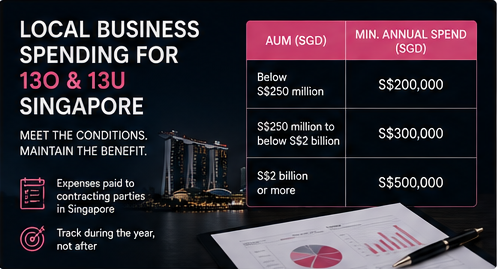
The current tiers are:
- AUM below S$250 million: minimum S$200,000 local business spending
- AUM from S$250 million to below S$2 billion: minimum S$300,000
- AUM of S$2 billion or more: minimum S$500,000
The relevant AUM is the amount invested in designated investments at the end of the financial year.
Do these rules apply immediately to every 13O and 13U fund?
Not necessarily.
The applicable spending requirement can depend on when the incentive award commenced and the transition provisions that apply to that particular fund.
Some existing incentive holders may continue to apply an earlier spending requirement for a transition period before the tiered local business spending rules become applicable.
The fund's MAS approval letter, subsequent MAS correspondence and current conditions should therefore be checked rather than assuming that the latest tier automatically applies to every financial year.
Why tracking during the year matters
A fund can easily discover too late that an expense was paid to an overseas service provider, was classified incorrectly, or does not count towards the Singapore spending requirement in the way expected.
A simple year-to-date schedule can show:
- qualifying local expenses incurred to date
- the applicable annual spending target
- the remaining amount required before year end
- which expenses still need supporting documents
- whether the AUM tier may change the required amount
Common problems
Common issues include:
- assuming all operating expenses count as local business spending
- not checking where the contracting party is located
- tracking total spending instead of qualifying Singapore spending
- waiting until year end to calculate the amount
- using the wrong AUM tier
- overlooking transition rules for an older 13O or 13U award
- not keeping invoices and supporting schedules organised
Keep a local spending schedule
The practical approach is to maintain a separate schedule throughout the year.
It should reconcile back to the accounting records and identify:
- supplier or contracting party
- nature of expense
- amount
- Singapore or overseas counterparty
- whether it has been included in the local business spending calculation
- supporting invoice or document
This makes year-end compliance much easier and gives the fund time to address a potential shortfall before the financial year closes.
How CFOSg can help
We can support the finance side of the process by helping to:
- keep the accounts current
- classify and reconcile operating expenses
- maintain local business spending schedules
- compare year-to-date spending against the applicable target
- prepare supporting information for year-end compliance work
- coordinate with your tax, fund management and other advisers where needed
The exact incentive conditions should always be checked against the fund's own approval terms and current MAS requirements.
Related family office guides
For the wider annual compliance process, read 13O annual compliance support Singapore and 13O tax filing Singapore .