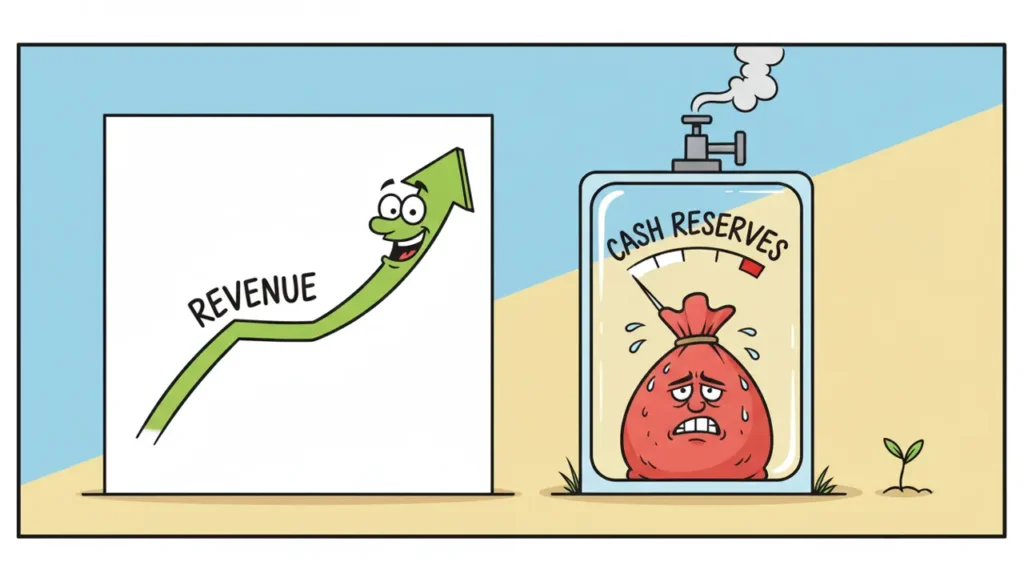
Spendable Revenue: Why Higher Sales Can Still Leave You Short
Spendable Revenue helps owners understand how much remains after the direct costs required to deliver their sales are considered.
Total sales may look impressive, but some of that money is already committed to materials, subcontractors, fulfilment and other costs connected directly to the work.
The amount remaining provides a more useful base for reviewing operating expenses, pricing and profit.
Why The Base Matters
Most financial reports begin with sales. That is correct and useful for accounting.
But sales alone may not explain why the business still feels financially tight.
Two businesses may each produce $100,000 in sales. One may require $20,000 of direct delivery costs, while the other requires $45,000.
Their sales are the same, but the amount left to support rent, permanent payroll, administration and profit is very different.
This is why pricing decisions should consider more than total revenue.
The Normal Sales View
Consider a business producing $100,000 in sales during a period.
| Area | Amount | Percentage Of Sales |
|---|---|---|
| Sales | $100,000 | 100% |
| Direct delivery costs | ($45,000) | 45% |
| Operating expenses | ($40,000) | 40% |
| Profit | $15,000 | 15% |
The business earns $15,000 of profit from $100,000 in sales.
A 15% profit margin may appear reasonable, but it can still be vulnerable to supplier increases, discounts, rework or slower customer collections.
The Spendable Revenue View
The same business has $55,000 remaining after direct delivery costs.
| Area | Amount |
|---|---|
| Amount remaining after direct delivery costs | $55,000 |
| Operating expenses | ($40,000) |
| Profit | $15,000 |
The profit result has not changed. This is simply a different management view of the same numbers.
It shows that the business is not using the full $100,000 to support overhead. It has $55,000 remaining after delivery costs, and $40,000 of that amount is already required for operating expenses.
| Same $40,000 Of Operating Expenses | Sales View | Spendable Revenue View |
|---|---|---|
| Amount used as the comparison base | $100,000 | $55,000 |
| Operating expenses as a percentage | 40% | About 73% |
Three Pricing Checks Before Increasing Prices
A price increase can improve profit significantly, but only when the assumptions behind it are realistic.
1. Which Costs Move With Quantity?
Some costs rise whenever the business delivers another unit, order or job.
Examples may include:
- Materials and packaging.
- Subcontractor charges.
- Payment-processing fees.
- Delivery and fulfilment costs.
- Sales commissions.
If the price rises but the business delivers the same quantity using the same inputs, these costs may remain broadly unchanged.
If volume changes, the direct costs are also likely to change.
2. Will More Work Increase Operating Expenses?
Operating expenses may appear fixed until the business reaches its current capacity.
Higher sales can create:
- Overtime.
- More administration.
- Additional software or tools.
- More customer support.
- Extra rework, refunds or delivery problems.
A pricing decision should therefore consider whether the business can support the expected volume without adding new overhead.
3. Will Customers Accept The New Price?
A price increase improves the financial result only if enough suitable customers continue buying.
The owner should review:
- How clearly the offer communicates its value.
- Whether the current price is below the market or delivery requirement.
- Which customers are most sensitive to price.
- Whether discounts are likely to weaken the increase.
- Whether the business can afford some reduction in volume.
The objective is not to assume nobody will leave. It is to understand how much volume the business can lose before the increase stops helping.
A Simplified 10% Price-Increase Example
Assume the business increases its prices by 10%, sells the same quantity and incurs the same direct and operating costs.
| Area | Before | After 10% Price Increase |
|---|---|---|
| Sales | $100,000 | $110,000 |
| Direct delivery costs | ($45,000) | ($45,000) |
| Operating expenses | ($40,000) | ($40,000) |
| Profit | $15,000 | $25,000 |
Sales increase by 10%, while profit rises from $15,000 to $25,000.
That larger percentage improvement happens because the additional revenue is not being absorbed by an equal increase in costs.
How Much Volume Could Fall?
Owners often worry that a higher price will reduce customer volume.
That concern is valid. The question is how much volume could fall before the business returns to its original $15,000 profit.
In this simplified example:
- The selling price increases by 10%.
- Direct costs change with quantity rather than price.
- Operating expenses remain at $40,000.
- The mix of products or services remains the same.
Under those assumptions, volume could fall by about 15% before profit returns to approximately the original $15,000 level.
This does not mean every business can safely lose 15% of its customers. The result will differ when products, margins, customer behaviour or capacity requirements change.
Why The Price Increase May Still Disappoint
A higher price does not automatically create a healthier profit.
The improvement may be weakened when:
- Supplier prices increase.
- More materials are wasted.
- Additional subcontracting is required.
- Overtime and administration increase.
- The business gives the increase back through discounts.
- The wrong customers leave while expensive-to-serve customers remain.
- The offer does not provide enough value to justify the new price.
This is why pricing should be reviewed together with costs, customer fit and delivery capacity.
Do Not Apply One Pricing Decision To Every Offer
A business may sell several products or services with different cost structures.
One offer may require significant materials and subcontractor time. Another may use existing internal capacity and produce a stronger result.
Before changing prices across the board, review whether each important offer:
- Covers the direct work required.
- Contributes enough towards overhead.
- Leaves an acceptable profit.
- Can be delivered consistently.
- Attracts customers the business wants more of.
This helps management avoid increasing prices blindly or continuing to underprice work that has become expensive to deliver.
Review Pricing During Monthly Money Day
Pricing does not need to change every month.
But during the monthly Money Day, the owner can review whether current prices are producing a healthier Cash, Profit and Revenue position.
Useful questions include:
- Did sales increase without a similar improvement in profit?
- Did direct delivery costs rise unexpectedly?
- Is one product, service or customer weakening the result?
- Are discounts reducing the intended price?
- Does one important offer need a closer pricing review?
The purpose is to spot where pricing or delivery needs attention before another busy month passes.
The Better Pricing Question
Do not ask only:
“How much should we increase the price?”
Ask:
“What will this price change do to the amount the business keeps after delivery costs and overhead?”
Spendable Revenue provides a clearer management view for that discussion. It helps the owner avoid treating the full sales figure as money freely available to spend.
Reference: Contribution margin overview
Related: Use The CFOSg Calculators • CPR Compass™ • Profit-Ready by CFOSg™
Are Higher Sales Still Leaving Too Little Profit?
CFOSg can help review whether your pricing, direct costs and Xero reports explain what the business is actually keeping.
Book A 15-Minute Call See Xero Services