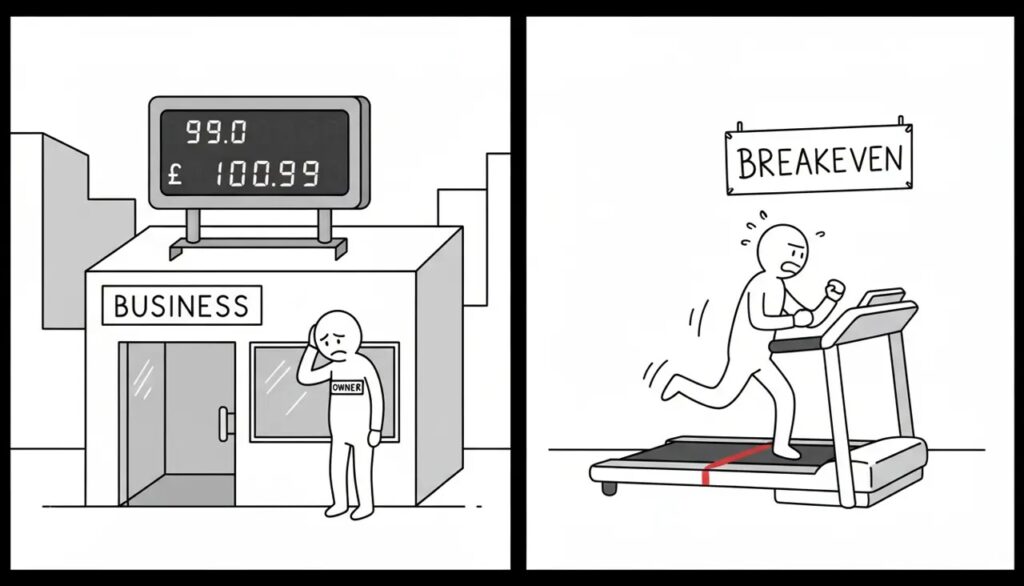
How To Calculate Break-Even When Costs Change
Use a baseline plus a simple update rule so break-even stays useful.
- Your costs swing so you avoid targets.
- Break-even feels too hard to maintain.
- You want a repeatable method.
- Set baseline fixed costs (3-month average).
- Update only big movers monthly (payroll, rent, loans).
- Recalculate and compare to last month.
Do I need perfect categories?
No. You need a consistent method and review routine.
Where do variable costs fit?
They sit inside gross margin %. Keep the estimate realistic.
How often should I update?
Monthly. Review weekly against the target.
What is a warning sign?
Break-even rising faster than revenue or cash-in.
First action if break-even is too high?
Improve margin or reduce fixed commitments.
How To Calculate Break-Even When Costs Change
Calculate break-even with a baseline first, then update the few cost lines that actually changed. That keeps your target simple, current, and useful for weekly decisions.
Who This Is For
- Your costs swing, so your revenue target keeps feeling wrong.
- You avoid break-even because it seems too hard to maintain.
- You want a repeatable monthly update instead of redoing everything.
What To Do This Week
- Set a baseline using a 3-month average of fixed operating costs.
- Update only the big movers such as payroll, rent, software, and recurring overhead.
- Recalculate break-even and compare it with last month’s number.
How To Calculate Break-Even With A Baseline
Most owners make break-even too complicated. You do not need a giant spreadsheet every week. Start with a clean baseline and update only the numbers that move enough to matter.
Your baseline should include fixed operating costs that usually stay the same month to month. That may include rent, salaries, software, insurance, admin support, and other recurring overhead. Then estimate your contribution margin ratio. That is the share of each sales dollar left after direct or variable costs.
Use this simple formula:
Break-even sales = Fixed costs ÷ Contribution margin ratio
Example:
- Fixed costs = $20,000
- Contribution margin ratio = 40%
- Break-even sales = $20,000 ÷ 0.40 = $50,000
That means you need about $50,000 in sales just to cover operating costs before profit. Once you calculate break-even this way, you have a baseline you can update instead of rebuilding from zero.
How To Calculate Break-Even When Costs Change Monthly
When costs change, do not panic and throw out the whole model. Just adjust the lines that moved.
For example, if payroll rises by $2,000, rent increases by $500, and software goes up by $200, your fixed costs have increased by $2,700. Add that to your previous baseline. Then calculate break-even again using the same contribution margin ratio unless your direct costs changed too.
If the new fixed cost total is $22,700 and your contribution margin ratio is still 40%, your updated break-even sales become $56,750. That is the new monthly line to watch.
This is the easiest way to calculate break-even when costs change because it protects consistency. You are not chasing perfection. You are building a planning habit. That matters more than having a fancy dashboard that nobody trusts.
Calculate Break-Even Before You Change Price Or Hire
Break-even is not just a finance exercise. It is a decision filter. Before you cut prices, hire someone, add office space, or take on extra overhead, calculate break-even again first.
A higher break-even point means you need more sales before you make any real money. That is why businesses can grow revenue and still feel broke. Costs rise quietly, but the target moves faster than the owner notices.
Use break-even as an early warning sign. If your break-even target rises but your average monthly sales do not, you are carrying more pressure than before. If your margin falls at the same time, the problem gets worse because you now need even more sales just to stand still.
Common Mistakes When You Calculate Break-Even
- Using old fixed cost numbers from six months ago.
- Forgetting that margin changes when direct costs rise.
- Including too many tiny categories and making the model annoying to maintain.
- Reviewing break-even once, then never updating it.
- Using break-even as a theory number instead of a weekly planning tool.
A simple model reviewed monthly is usually more useful than a perfect model ignored for six months.
Helpful References
Want the standard formula from an external source? See Xero’s break-even point formula or read Investopedia’s break-even analysis guide.
FAQ About How To Calculate Break-Even
Do I need perfect categories?
No. You need a consistent method and a review routine.
Where do variable costs fit?
They sit inside your contribution margin ratio. Keep that estimate realistic.
How often should I update break-even?
Update it monthly. Review weekly against actual sales and cash-in.
What is a warning sign?
A warning sign is when break-even rises faster than revenue, margin, or cash collection.
What should I do first if break-even is too high?
Check margin first, then review fixed overhead you can reduce, delay, or redesign.