ECI guide
Does a 13O company need to file ECI in Singapore?
A Section 13O company should still review its Estimated Chargeable Income (ECI) position after each financial year end.
Having a 13O tax incentive does not automatically mean there is nothing to file.
The key question is whether the company qualifies for the ECI filing waiver.
When does a company need to file ECI?
Companies generally need to file ECI within three months after the end of their financial year.
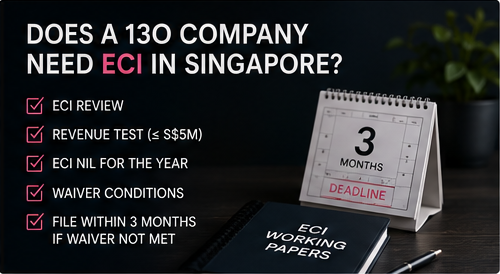
However, IRAS provides an ECI filing waiver where both of these conditions are met:
- annual revenue is S$5 million or less; and
- ECI is nil for that Year of Assessment.
Both conditions must be satisfied.
If either condition is not met, the company should generally file its ECI within the required timeline.
What does annual revenue mean for an investment holding company?
Do not assume that an investment holding company has no revenue simply because it does not have normal trading sales.
For an investment holding company, revenue can include investment income such as dividends and interest recorded in the accounts. This means the S$5 million revenue test still needs to be checked properly.
What should a 13O company check?
After year end, review:
- the company's annual revenue
- its taxable and tax-exempt income streams
- deductible expenses and relevant adjustments
- whether the resulting ECI is nil
- whether both conditions for the ECI filing waiver are met
A company can have substantial investment income and still have little or no taxable income because qualifying income may be exempt under Section 13O. That does not remove the need to work through the ECI position properly.
What if the ECI is nil?
Nil ECI by itself does not automatically remove the filing requirement.
The company must also meet the annual revenue threshold for the filing waiver. If annual revenue exceeds S$5 million, an ECI filing may still be required even where the estimated chargeable income is nil.
ECI is separate from the annual tax return
The ECI review is only one part of the annual corporate tax process.
A 13O company may still need to file its annual Corporate Income Tax Return with IRAS even if it qualifies for the ECI filing waiver. The appropriate income tax return and the treatment of exempt income should therefore be reviewed separately.
Keep the working papers ready
The practical approach is simple:
- close the accounts promptly after year end
- reconcile the investment and bank records
- identify taxable and exempt income correctly
- calculate the ECI position
- document why the filing waiver applies, if relevant
- file within three months if the waiver conditions are not met
The important point is not to assume that 13O approval automatically removes the ECI obligation. Check the numbers first.
Related 13O tax filing guides
For the bigger picture, read 13O tax filing Singapore and can a 13O company file Form C-S in Singapore? .