MAS annual admin
Family office annual declaration Singapore: what MAS still expects
For a Section 13O or 13U fund, the annual declaration is part of the ongoing compliance cycle after approval.
It is separate from the corporate income tax return filed with IRAS.
The practical issue is not just submitting a declaration.
The fund needs records that support whether the applicable incentive conditions continued to be met during the financial year.
When is the MAS annual declaration due?
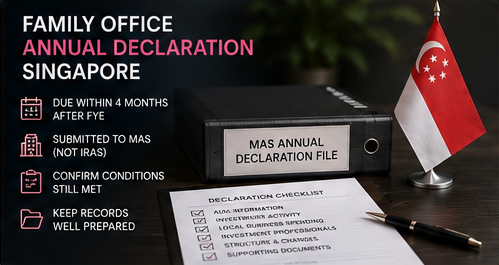
Under the current framework, relevant Section 13O and 13U funds generally submit their annual declaration to MAS within four months after the end of each financial year.
The fund should still check its own MAS approval letter, subsequent correspondence and current incentive conditions because transitional or fund-specific requirements may apply.
The MAS annual declaration is not the IRAS tax return
These are separate workstreams.
The corporate income tax return is filed with IRAS.
The annual declaration is submitted to MAS as part of the fund's ongoing tax incentive compliance.
A fund may therefore have several year-end tasks running at the same time, including:
- closing the annual accounts
- preparing the tax computation and corporate income tax return
- preparing the MAS annual declaration
- checking whether the ongoing Section 13O or 13U conditions were met
What usually needs to be checked?
Depending on the incentive and the applicable conditions, the annual review may include information relating to:
- assets under management
- investment activity and designated investments
- local business spending
- investment professionals and staffing requirements
- fund management arrangements
- changes to the fund or family office structure
- other conditions stated in the MAS approval
The exact checklist depends on whether the fund is under Section 13O or Section 13U, when the incentive commenced and the terms applicable to that particular structure.
What finance records should be ready?
A well-prepared year-end file may include:
- final or substantially completed accounts
- reconciled bank and broker statements
- investment schedules
- dividend and interest income schedules
- local business spending schedules
- supporting invoices and contracts
- updated structure information
- records of material changes during the year
- supporting documents for other applicable incentive conditions
Why people underestimate the annual declaration
The declaration can look like a small administrative task. In practice, it depends on information accumulated throughout the year.
If the books are late, spending has not been tracked, investment schedules do not reconcile or nobody has recorded changes to the structure, the annual declaration becomes much harder to prepare.
Good annual compliance therefore starts before year end.
Keep an annual compliance file during the year
A practical approach is to maintain one ongoing compliance file containing:
- the MAS approval letter
- the current conditions checklist
- monthly or quarterly finance records
- local business spending tracking
- AUM information
- supporting documents for staffing and other relevant requirements
- notes of material changes requiring adviser review
This reduces the amount of information that has to be reconstructed after the financial year closes.
How CFOSg can support the process
We can support the finance preparation side by helping with:
- bookkeeping and reconciliations
- year-end schedules
- local business spending tracking
- management and investment reporting
- preparation of finance information needed for the annual declaration
- corporate tax filing support
- coordination with your fund manager, tax adviser, corporate secretary and other professional advisers
The final compliance position should always be checked against the fund's own approval terms and current MAS requirements.
Related family office guides
See 13O annual compliance support Singapore , local business spending for 13O and 13U and family office accounting services Singapore .