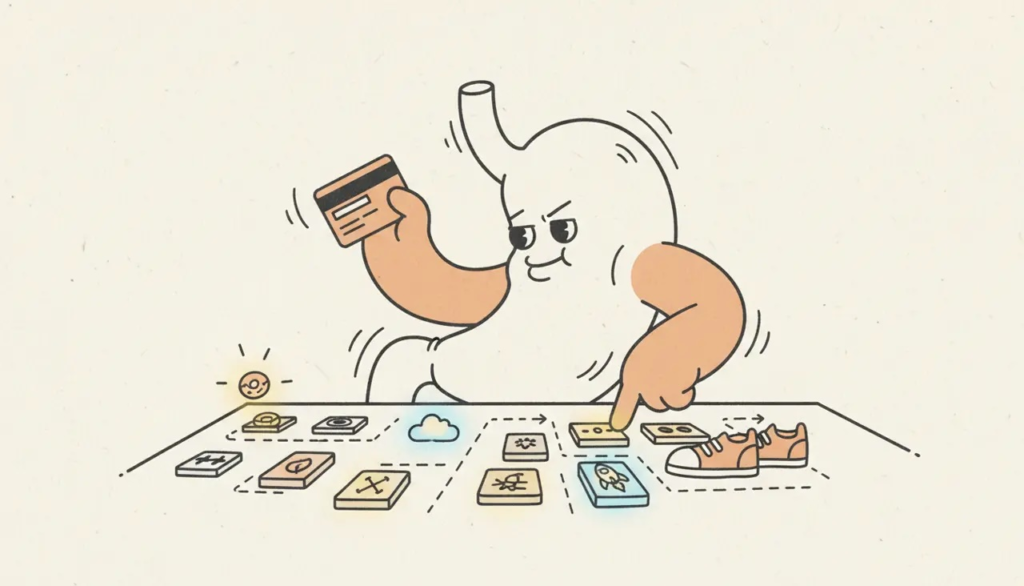
“3rd-order decision” sounds like a MBA word. It is actually a simple way to stop fixing the same money problems every month.
1st-order feels good now.
2nd-order is what it costs you later.
3rd-order is what it trains your business to become.
Think of how our children learn money.
They get pocket money, and they want two things:
- a quick candy today
- a toy they really want later
If they spend the pocket money on candy, they get instant relief.
But the toy never happens.
You are not choosing between candy and toy.
You are choosing between a habit of instant spending, or a habit of funding what matters.
Business is the same.
The “candy” is usually revenue-first fixes that feel good now:
- discounting to get quick sales
- taking low-margin work to feel busy
- spending on ads to feel proactive
And the “toy” is what you actually want:
- stable cashflow
- profit that stays
- a business that does not need panic every week
A 3rd-order decision asks one question before you act:
If I repeat this choice for 90 days, am I saving for the toy, or am I buying candy every day?
When I say “revenue should be a 3rd-order decision,” I am not trying to sound fancy.
I am describing a pattern I see in almost every stressed business:
- Something feels tight.
- The owner does the fastest thing that creates relief.
- The relief creates a new problem.
- Next month, they repeat it again.
That loop is not a motivation problem.
It is a decision-order problem.
What “3rd-order decision” means (no theory)
Here is the simplest way to think about it:
1st-order: What happens immediately?
2nd-order: What happens next?
3rd-order: What pattern does this create if I repeat it?
They optimise for relief, not for results.
Example 1: “Let’s do a discount to boost sales”
1st-order: Sales jump. You feel safe again.
2nd-order: Margin drops. You need more volume to get the same profit.
3rd-order: Customers learn to wait for discounts. Your pricing power dies.
That is why “more sales” does not always mean more money.
Sometimes it means you are training your business to survive only on promos.
Example 2: “Let’s hire because we’re busy”
1st-order: The team gets relief. Delivery feels smoother.
2nd-order: Fixed costs rise. Cash gets tighter in slow weeks.
3rd-order: You build a business that needs constant growth just to pay the overhead.
This is how owners end up saying:
“We have to keep selling, because the burn rate is insane.”
Example 3: “Let’s spend on ads to fix cashflow”
1st-order: You feel proactive. Leads come in.
2nd-order: Cash goes out now, results come later. Your runway shrinks.
3rd-order: Your business becomes dependent on paid traffic for oxygen.
Why this matters for money decisions
Money pressure makes first-order decisions feel necessary.
That is why owners default to:
- discounting
- adding more clients
- pushing more offers
- buying more tools
- working longer hours
These are not always wrong.
They are wrong when they become your automatic first move.
How CPR Compass™ uses decision order (Cash, Profit, Revenue)
CPR is a decision order, not just a framework.
Cash first: it forces reality.
- What is actually in the bank?
- What must be paid in the next 7–14 days?
- What is safe to spend this week?
Profit next: it forces discipline.
- Profit is protected before Opex can eat it.
- Spending stays inside a cap.
- You stop “borrowing” profit for emotional purchases.
Revenue last: it forces quality.
- Revenue becomes a pace number, not a vanity goal.
- You focus on collections speed and margin quality.
- You stop chasing volume that creates future pain.
If you want the full CPR breakdown, start here: CPR explained (Cash, Profit, Revenue).
Because “sell more” is the most expensive way to fix a money problem.
The 3-question test (use this weekly)
Before you “fix” anything with sales, ask:
- 1st-order: What relief will this give me today?
- 2nd-order: What will it cost me next week or next month?
- 3rd-order: If I repeat this for 90 days, what kind of business will I build?
If the 3rd-order answer is “a business that needs me to panic forever,” do not do it.
Related reads
You are just choosing a 1st-order relief that creates 2nd-order pain and 3rd-order fragility.