
Tools & templates
Simple resources to help you check cash, protect profit, and improve revenue decisions.
Cash resources
Check what is safe to spend before money leaks.
- Safe-to-spend calculator
- Committed payments template
- Cash runway template
Profit resources
Protect profit and stop small leaks from growing.
- Discount cost calculator
- Profit transfer template
- Pricing review template
Revenue resources
Check if sales are really covering your business.
- Break-even calculator
- Sales mix template
- Revenue quality template
Not sure which one to use first?
Start with the free masterclass. It shows how to use Xero as a simple weekly decision system, not just a bookkeeping file.
View free masterclassUse these resources to decide what is safe to spend before money leaks out.
See how much cash is really available after the bills and payments coming up soon.
Use this before approving spending, owner pay, or non-urgent purchases.
Why it matters: one bank balance can make you feel richer than you really are.
Use this weekly cash template to stop spending money that is already spoken for.
Copy template
Safe-To-Spend (Weekly)

Date:
Operating bank balance (today):
Committed payments next 14 days (total):

Safe-To-Spend = Operating balance - Committed payments

Spending rule:
- If Safe-To-Spend is negative: freeze optional spending
- If Safe-To-Spend is low: approve only essentials

Notes (1 line):
Decision this week (pick 1): collect / delay / renegotiate / cut / reprice
Use this weekly cash template to build a simple truth list for cash decisions.
Copy template
Committed Payments (Next 14 Days)

Due date | Payee | Amount | Must pay? (Y/N) | Status (scheduled/paid)

Rules:
- Must pay = payroll, rent, loans, tax due, critical suppliers
- Everything else is “maybe” until Safe-To-Spend allows it
Use this cash runway template weekly to see how many weeks your business can survive if sales wobble.
Copy template
Cash Runway (Weekly)

Available cash (operating + any cash you will actually use):
Weekly fixed outflows (payroll + rent + loans + core overhead):

Runway (weeks) = Available cash / Weekly fixed outflows

Trigger rule:
- If runway drops below ____ weeks: freeze optional spend + tighten collections + renegotiate terms
Use this weekly collection template to stay on top of your top 10 invoices. Consistency beats one big chase at month-end.
Copy templates
Debtor Follow-Up (3 Touches)

Touch 1 (WhatsApp / SMS)
Hi [Name], quick one. Invoice [#] for $[amount] is due on [date]. Can you confirm payment date? Thanks.

Touch 2 (Email)
Subject: Invoice [#] due – please confirm payment date
Hi [Name],
Just following up on invoice [#] for $[amount], due on [date].
Please reply with the payment date so we can update our records.
Thanks,
[Your name]

Touch 3 (Call script)
Hi [Name], it’s [Your name]. Calling about invoice [#] for $[amount] due on [date].
- Are you able to process today?
- If not, what exact date will it be paid?
- If there’s an issue, let’s resolve it now so it doesn’t drag.
Use these resources when revenue is coming in, but profit is still too thin.
See how much profit a discount eats up and how much extra sales you need to recover it.
Useful before you say yes to “just give me 10% off.”
Why it matters: a small discount can quietly create a much bigger sales problem.
Use this profit template weekly. Start small and make profit a habit, not leftovers.
Copy template
Weekly Profit Transfer

Date:
Cash received this week:
Profit transfer % (start 1–3%):
Profit transfer amount = Cash received x %

Transfer date:
Profit account balance (after transfer):

Rule:
- Profit account is not for random spending
- You decide usage monthly or quarterly, not daily
Use this profit audit template monthly and do a quick check weekly to catch leaks early.
Copy checklist
Margin Leak Audit (10 Min)

Pick 1 period: last week / last month

Check these:
1) Discounting increased?
2) Scope creep happened without price change?
3) Supplier costs increased?
4) Overtime / extra labour increased?
5) Wastage increased?
6) Subscription creep?
7) Refunds / rework increased?
8) Low-margin jobs increasing share?
9) Delivery time per job increasing?
10) Any “small” expense growing weekly?

This week’s one fix:
Owner:
Due date:
Use this pricing discipline template whenever a discount request shows up. Discounts should be intentional, not automatic.
Copy policy + scripts
Discount Rule (Simple)

Default rule:
- No discounts unless one of these is true:
  A) Scope reduced
  B) Terms improved (deposit, milestones, faster payment)
  C) Bundle replaces discount
  D) Strategic exception approved

Approval question (1 line):
What are we trading for the discount?

Client script:
I can help, but I don’t discount price without changing scope or terms.
Which one works for you:
- Smaller scope for same budget
- Same scope with deposit/milestones
- Bundle option (best value)
Use this pricing review template quarterly or any time profit keeps getting pushed to later.
Copy template
Pricing Review (Top 3 Offers)

Offer | Price | Rough delivery cost | Rough gross margin | Pain points

For each offer, choose 1 move:
- Raise price
- Reduce scope
- Improve terms (deposit/milestones)
- Stop selling it
- Bundle it

This week’s test:
Offer:
Change:
Start date:
Use these resources when sales are happening, but you need to check whether enough cash is actually coming in.
See the minimum sales needed to cover your fixed monthly costs at your current margin.
This is your break-even sales number.
Why it matters: it shows whether the business is truly covering itself or just staying busy.
Use this revenue template monthly and compare your weekly trend against it.
Copy template
Break-Even (Monthly)

Fixed monthly costs (total):
Gross margin % (rough estimate):

Break-even sales = Fixed costs / Gross margin %

Weekly check:
Cash-in this week:
Are we above or below break-even trend?

One action this week:
Use this revenue mix template monthly to make sure you are growing the right sales, not just more sales.
Copy template
Sales Mix (Top 5)

Product/Service | Revenue | Rough margin (High/Med/Low) | Keep/Pause/Fix

Rule:
- Stop pushing the worst-margin “popular” offer
- Push your best-margin offer with best payment behaviour
Use this revenue quality template monthly. Bad revenue creates stress even when sales look good.
Copy template
Revenue Quality (Top 10 Clients)

Client | Pays on time? (Y/N) | Margin (H/M/L) | Effort (H/M/L) | Keep/Fix/Exit

Fast fixes:
- Deposit
- Milestones
- Scope boundaries
- Reprice
- Stop taking this type of work
Use this payment terms template all the time to pull cash forward, reduce chasing, and lower stress.
Copy policy + scripts
Terms Policy (Simple)

Default:
- Deposit: ____%
- Milestones: invoice at each stage
- Due date: ____ days
- Work pauses if invoices are overdue by ____ days

Client script:
To keep delivery smooth, we start with a deposit and we invoice by milestone.
This protects timelines and prevents surprises for both sides.
Use these to keep the weekly money routine simple and practical.
Use this weekly Money Day template to create a boring but powerful habit that gives you more control.
Copy checklist
Money Day (Weekly)

1) Check operating bank balance
2) List committed payments next 7–14 days
3) Safe-to-spend = operating cash - committed payments
4) Transfer profit (small, consistent)
5) Review top 10 receivables (follow-up)
6) Approve spending only within safe-to-spend
7) Do one action: collect / delay / renegotiate / cut / reprice
8) Write one note: what changed + what you decided
Use this month-end template to keep your financial close simple enough to actually finish.
Copy checklist
Month-End Minimum Close

1) Reconcile bank accounts
2) Review receivables (overdue list)
3) Review payables (due in next 30 days)
4) Check gross margin trend (up/down)
5) Check top 5 expense categories (any spikes?)
6) Confirm tax set-aside if applicable
7) Pick one fix for next month
Want Xero to show you what to fix first?
The resources help you check one number at a time. The Profit-Ready Xero system helps you turn those numbers into a weekly decision routine.
View free masterclassTools & templates
Simple resources to help you check cash, protect profit, and improve revenue decisions.
Cash tools
Check what is safe to spend before money leaks.
- Safe-to-spend
- Committed payments
- Cash runway
Profit templates
Protect profit and stop small leaks from growing.
- Profit transfer
- Margin leak audit
- Pricing review
Revenue tools
Check if sales are really covering your business.
- Break-even
- Sales mix
- Revenue quality
Not sure which one to use first?
Start with the free masterclass. It shows how to use Xero as a simple weekly decision system, not just a bookkeeping file.
View free masterclassUse these tools to decide what is safe to spend before money leaks out.
See how much cash is really available after the bills and payments coming up soon.
Use this before approving spending, owner pay, or non-urgent purchases.
Why it matters: one bank balance can make you feel richer than you really are.
Use this weekly cash template to stop spending money that is already spoken for.
Copy template
Safe-To-Spend (Weekly)

Date:
Operating bank balance (today):
Committed payments next 14 days (total):

Safe-To-Spend = Operating balance - Committed payments

Spending rule:
- If Safe-To-Spend is negative: freeze optional spending
- If Safe-To-Spend is low: approve only essentials

Notes (1 line):
Decision this week (pick 1): collect / delay / renegotiate / cut / reprice
Use this weekly cash template to build a simple truth list for cash decisions.
Copy template
Committed Payments (Next 14 Days)

Due date | Payee | Amount | Must pay? (Y/N) | Status (scheduled/paid)

Rules:
- Must pay = payroll, rent, loans, tax due, critical suppliers
- Everything else is “maybe” until Safe-To-Spend allows it
Use this cash runway template weekly to see how many weeks your business can survive if sales wobble.
Copy template
Cash Runway (Weekly)

Available cash (operating + any cash you will actually use):
Weekly fixed outflows (payroll + rent + loans + core overhead):

Runway (weeks) = Available cash / Weekly fixed outflows

Trigger rule:
- If runway drops below ____ weeks: freeze optional spend + tighten collections + renegotiate terms
Use this weekly collection template to stay on top of your top 10 invoices. Consistency beats one big chase at month-end.
Copy templates
Debtor Follow-Up (3 Touches)

Touch 1 (WhatsApp / SMS)
Hi [Name], quick one. Invoice [#] for $[amount] is due on [date]. Can you confirm payment date? Thanks.

Touch 2 (Email)
Subject: Invoice [#] due – please confirm payment date
Hi [Name],
Just following up on invoice [#] for $[amount], due on [date].
Please reply with the payment date so we can update our records.
Thanks,
[Your name]

Touch 3 (Call script)
Hi [Name], it’s [Your name]. Calling about invoice [#] for $[amount] due on [date].
- Are you able to process today?
- If not, what exact date will it be paid?
- If there’s an issue, let’s resolve it now so it doesn’t drag.
Use these when revenue is coming in, but profit is still too thin.
See how much profit a discount eats up and how much extra sales you need to recover it.
Useful before you say yes to “just give me 10% off.”
Why it matters: a small discount can quietly create a much bigger sales problem.
Use this profit template weekly. Start small and make profit a habit, not leftovers.
Copy template
Weekly Profit Transfer

Date:
Cash received this week:
Profit transfer % (start 1–3%):
Profit transfer amount = Cash received x %

Transfer date:
Profit account balance (after transfer):

Rule:
- Profit account is not for random spending
- You decide usage monthly or quarterly, not daily
Use this profit audit template monthly and do a quick check weekly to catch leaks early.
Copy checklist
Margin Leak Audit (10 Min)

Pick 1 period: last week / last month

Check these:
1) Discounting increased?
2) Scope creep happened without price change?
3) Supplier costs increased?
4) Overtime / extra labour increased?
5) Wastage increased?
6) Subscription creep?
7) Refunds / rework increased?
8) Low-margin jobs increasing share?
9) Delivery time per job increasing?
10) Any “small” expense growing weekly?

This week’s one fix:
Owner:
Due date:
Use this pricing discipline template whenever a discount request shows up. Discounts should be intentional, not automatic.
Copy policy + scripts
Discount Rule (Simple)

Default rule:
- No discounts unless one of these is true:
  A) Scope reduced
  B) Terms improved (deposit, milestones, faster payment)
  C) Bundle replaces discount
  D) Strategic exception approved

Approval question (1 line):
What are we trading for the discount?

Client script:
I can help, but I don’t discount price without changing scope or terms.
Which one works for you:
- Smaller scope for same budget
- Same scope with deposit/milestones
- Bundle option (best value)
Use this pricing review template quarterly or any time profit keeps getting pushed to later.
Copy template
Pricing Review (Top 3 Offers)

Offer | Price | Rough delivery cost | Rough gross margin | Pain points

For each offer, choose 1 move:
- Raise price
- Reduce scope
- Improve terms (deposit/milestones)
- Stop selling it
- Bundle it

This week’s test:
Offer:
Change:
Start date:
Use these when sales are happening, but you need to check whether enough cash is actually coming in.
See the minimum sales needed to cover your fixed monthly costs at your current margin.
This is your break-even sales number.
Why it matters: it shows whether the business is truly covering itself or just staying busy.
Use this revenue template monthly and compare your weekly trend against it.
Copy template
Break-Even (Monthly)

Fixed monthly costs (total):
Gross margin % (rough estimate):

Break-even sales = Fixed costs / Gross margin %

Weekly check:
Cash-in this week:
Are we above or below break-even trend?

One action this week:
Use this revenue mix template monthly to make sure you are growing the right sales, not just more sales.
Copy template
Sales Mix (Top 5)

Product/Service | Revenue | Rough margin (High/Med/Low) | Keep/Pause/Fix

Rule:
- Stop pushing the worst-margin “popular” offer
- Push your best-margin offer with best payment behaviour
Use this revenue quality template monthly. Bad revenue creates stress even when sales look good.
Copy template
Revenue Quality (Top 10 Clients)

Client | Pays on time? (Y/N) | Margin (H/M/L) | Effort (H/M/L) | Keep/Fix/Exit

Fast fixes:
- Deposit
- Milestones
- Scope boundaries
- Reprice
- Stop taking this type of work
Use this payment terms template all the time to pull cash forward, reduce chasing, and lower stress.
Copy policy + scripts
Terms Policy (Simple)

Default:
- Deposit: ____%
- Milestones: invoice at each stage
- Due date: ____ days
- Work pauses if invoices are overdue by ____ days

Client script:
To keep delivery smooth, we start with a deposit and we invoice by milestone.
This protects timelines and prevents surprises for both sides.
Use these to keep the weekly money routine simple and practical.
Use this weekly Money Day template to create a boring but powerful habit that gives you more control.
Copy checklist
Money Day (Weekly)

1) Check operating bank balance
2) List committed payments next 7–14 days
3) Safe-to-spend = operating cash - committed payments
4) Transfer profit (small, consistent)
5) Review top 10 receivables (follow-up)
6) Approve spending only within safe-to-spend
7) Do one action: collect / delay / renegotiate / cut / reprice
8) Write one note: what changed + what you decided
Use this month-end template to keep your financial close simple enough to actually finish.
Copy checklist
Month-End Minimum Close

1) Reconcile bank accounts
2) Review receivables (overdue list)
3) Review payables (due in next 30 days)
4) Check gross margin trend (up/down)
5) Check top 5 expense categories (any spikes?)
6) Confirm tax set-aside if applicable
7) Pick one fix for next month
Want Xero to show you what to fix first?
The tools help you check one number at a time. The Profit-Ready Xero system helps you turn those numbers into a weekly decision routine.
View free masterclassFree tools & templates for Xero users
Simple calculators, worksheets, and copy templates to help you check cash, protect profit, and spot revenue issues faster.
Cash tools
Use these when your bank balance looks okay, but you are not sure what is safe to spend.
- Safe-to-spend calculator
- Cash check worksheet
- Weekly money check template
Profit templates
Use these when revenue is coming in, but profit still feels too thin.
- Profit leak checklist
- Expense review template
- Profit protection worksheet
Revenue tools
Use these when sales are happening, but you are not sure if enough cash is actually coming in.
- Break-even revenue check
- Collected revenue tracker
- Sales gap worksheet
Not sure which one to use first?
Start with the free masterclass. It shows how to use Xero as a simple weekly decision system, not just a bookkeeping file.
View free masterclassUse these tools to decide what is safe to spend before money leaks out.
See how much cash is really available after the bills and payments coming up soon.
Use this before approving spending, owner pay, or non-urgent purchases.
Why it matters: one bank balance can make you feel richer than you really are.
Use this weekly cash template to stop spending money that is already spoken for.
Copy template
Safe-To-Spend (Weekly)

Date:
Operating bank balance (today):
Committed payments next 14 days (total):

Safe-To-Spend = Operating balance - Committed payments

Spending rule:
- If Safe-To-Spend is negative: freeze optional spending
- If Safe-To-Spend is low: approve only essentials

Notes (1 line):
Decision this week (pick 1): collect / delay / renegotiate / cut / reprice
Use this weekly cash template to build a simple truth list for cash decisions.
Copy template
Committed Payments (Next 14 Days)

Due date | Payee | Amount | Must pay? (Y/N) | Status (scheduled/paid)

Rules:
- Must pay = payroll, rent, loans, tax due, critical suppliers
- Everything else is “maybe” until Safe-To-Spend allows it
Use this cash runway template weekly to see how many weeks your business can survive if sales wobble.
Copy template
Cash Runway (Weekly)

Available cash (operating + any cash you will actually use):
Weekly fixed outflows (payroll + rent + loans + core overhead):

Runway (weeks) = Available cash / Weekly fixed outflows

Trigger rule:
- If runway drops below ____ weeks: freeze optional spend + tighten collections + renegotiate terms
Use this weekly collection template to stay on top of your top 10 invoices. Consistency beats one big chase at month-end.
Copy templates
Debtor Follow-Up (3 Touches)

Touch 1 (WhatsApp / SMS)
Hi [Name], quick one. Invoice [#] for $[amount] is due on [date]. Can you confirm payment date? Thanks.

Touch 2 (Email)
Subject: Invoice [#] due – please confirm payment date
Hi [Name],
Just following up on invoice [#] for $[amount], due on [date].
Please reply with the payment date so we can update our records.
Thanks,
[Your name]

Touch 3 (Call script)
Hi [Name], it’s [Your name]. Calling about invoice [#] for $[amount] due on [date].
- Are you able to process today?
- If not, what exact date will it be paid?
- If there’s an issue, let’s resolve it now so it doesn’t drag.
Use these when revenue is coming in, but profit is still too thin.
See how much profit a discount eats up and how much extra sales you need to recover it.
Useful before you say yes to “just give me 10% off.”
Why it matters: a small discount can quietly create a much bigger sales problem.
Use this profit template weekly. Start small and make profit a habit, not leftovers.
Copy template
Weekly Profit Transfer

Date:
Cash received this week:
Profit transfer % (start 1–3%):
Profit transfer amount = Cash received x %

Transfer date:
Profit account balance (after transfer):

Rule:
- Profit account is not for random spending
- You decide usage monthly or quarterly, not daily
Use this profit audit template monthly and do a quick check weekly to catch leaks early.
Copy checklist
Margin Leak Audit (10 Min)

Pick 1 period: last week / last month

Check these:
1) Discounting increased?
2) Scope creep happened without price change?
3) Supplier costs increased?
4) Overtime / extra labour increased?
5) Wastage increased?
6) Subscription creep?
7) Refunds / rework increased?
8) Low-margin jobs increasing share?
9) Delivery time per job increasing?
10) Any “small” expense growing weekly?

This week’s one fix:
Owner:
Due date:
Use this pricing discipline template whenever a discount request shows up. Discounts should be intentional, not automatic.
Copy policy + scripts
Discount Rule (Simple)

Default rule:
- No discounts unless one of these is true:
  A) Scope reduced
  B) Terms improved (deposit, milestones, faster payment)
  C) Bundle replaces discount
  D) Strategic exception approved

Approval question (1 line):
What are we trading for the discount?

Client script:
I can help, but I don’t discount price without changing scope or terms.
Which one works for you:
- Smaller scope for same budget
- Same scope with deposit/milestones
- Bundle option (best value)
Use this pricing review template quarterly or any time profit keeps getting pushed to later.
Copy template
Pricing Review (Top 3 Offers)

Offer | Price | Rough delivery cost | Rough gross margin | Pain points

For each offer, choose 1 move:
- Raise price
- Reduce scope
- Improve terms (deposit/milestones)
- Stop selling it
- Bundle it

This week’s test:
Offer:
Change:
Start date:
Use these when sales are happening, but you need to check whether enough cash is actually coming in.
See the minimum sales needed to cover your fixed monthly costs at your current margin.
This is your break-even sales number.
Why it matters: it shows whether the business is truly covering itself or just staying busy.
Use this revenue template monthly and compare your weekly trend against it.
Copy template
Break-Even (Monthly)

Fixed monthly costs (total):
Gross margin % (rough estimate):

Break-even sales = Fixed costs / Gross margin %

Weekly check:
Cash-in this week:
Are we above or below break-even trend?

One action this week:
Use this revenue mix template monthly to make sure you are growing the right sales, not just more sales.
Copy template
Sales Mix (Top 5)

Product/Service | Revenue | Rough margin (High/Med/Low) | Keep/Pause/Fix

Rule:
- Stop pushing the worst-margin “popular” offer
- Push your best-margin offer with best payment behaviour
Use this revenue quality template monthly. Bad revenue creates stress even when sales look good.
Copy template
Revenue Quality (Top 10 Clients)

Client | Pays on time? (Y/N) | Margin (H/M/L) | Effort (H/M/L) | Keep/Fix/Exit

Fast fixes:
- Deposit
- Milestones
- Scope boundaries
- Reprice
- Stop taking this type of work
Use this payment terms template all the time to pull cash forward, reduce chasing, and lower stress.
Copy policy + scripts
Terms Policy (Simple)

Default:
- Deposit: ____%
- Milestones: invoice at each stage
- Due date: ____ days
- Work pauses if invoices are overdue by ____ days

Client script:
To keep delivery smooth, we start with a deposit and we invoice by milestone.
This protects timelines and prevents surprises for both sides.
Use these to keep the weekly money routine simple and practical.
Use this weekly Money Day template to create a boring but powerful habit that gives you more control.
Copy checklist
Money Day (Weekly)

1) Check operating bank balance
2) List committed payments next 7–14 days
3) Safe-to-spend = operating cash - committed payments
4) Transfer profit (small, consistent)
5) Review top 10 receivables (follow-up)
6) Approve spending only within safe-to-spend
7) Do one action: collect / delay / renegotiate / cut / reprice
8) Write one note: what changed + what you decided
Use this month-end template to keep your financial close simple enough to actually finish.
Copy checklist
Month-End Minimum Close

1) Reconcile bank accounts
2) Review receivables (overdue list)
3) Review payables (due in next 30 days)
4) Check gross margin trend (up/down)
5) Check top 5 expense categories (any spikes?)
6) Confirm tax set-aside if applicable
7) Pick one fix for next month
Want Xero to show you what to fix first?
The tools help you check one number at a time. The Profit-Ready Xero system helps you turn those numbers into a weekly decision routine.
View free masterclassFree tools & templates to help you stop guessing with your numbers
Simple calculators, checklists, and templates to help you check cash, protect profit, and spot revenue issues faster.
View free masterclassStart with what you need most
Pick a resource based on the problem you want to fix first.
Cash tools
Use these when your bank balance looks okay, but you are not sure what is safe to spend.
- Safe-to-spend calculator
- Cash check worksheet
- Weekly money check template
Profit templates
Use these when revenue is coming in, but profit still feels too thin.
- Profit leak checklist
- Expense review template
- Profit protection worksheet
Revenue worksheets
Use these when sales are happening, but you are not sure if enough cash is actually coming in.
- Break-even revenue check
- Collected revenue tracker
- Sales gap worksheet
Not sure which tool to use first?
Start with the free masterclass. It shows how to use Xero as a simple weekly decision system, not just a bookkeeping file.
View free masterclassHow to use these resources
Do not try to use everything at once. Pick one problem and one tool.
1. Choose the issue
Cash, profit, or revenue. Start with the area that feels most messy right now.
2. Use one tool
Do one simple check. The goal is clarity, not another complicated spreadsheet.
3. Take one action
Decide what to pay, protect, collect, reduce, or review next.
Want Xero to show you what to fix first?
The tools help you check the numbers. The Profit-Ready Xero system helps you turn those numbers into a weekly decision routine.
View free masterclassIs your Xero profit-ready?
Your Xero may be updated, reconciled, and still not helping you make better money decisions.
Check the 3 warning signs most business owners miss.
Is your Xero profit-ready?
Your Xero may be updated, reconciled, and still not helping you make better cash, profit, and revenue decisions.
Your bank balance can lie.
That money may already belong to bills, payroll, GST, tax, or supplier payments.
The money is there.
But it may not be safe to spend.
Updated accounts are good. Useful accounts are better.
Most businesses use Xero to record what happened. But owners need to know what to do next.
Can I spend?
Can I pay myself?
Do I need more sales?
You do not know your safe-to-spend cash.
You may see cash in the bank, but still not know how much is actually available after upcoming commitments.
This is where accidental overspending starts.
You do not know what profit to protect.
If profit is not protected first, expenses usually find a way to eat it.
Profit disappears quietly before owners notice.
You do not know your revenue floor.
More sales are not always the answer. You need to know the minimum revenue needed to cover costs and protect profit.
Busy sales can still create cash stress.
Can your Xero answer this without digging?
Score cash, profit and revenue separately. Then add the 3 scores.
No idea
I would need to guess or ask someone.
Needs digging
The answer is there, but not easy to see.
Clear answer
I can decide quickly without guessing.
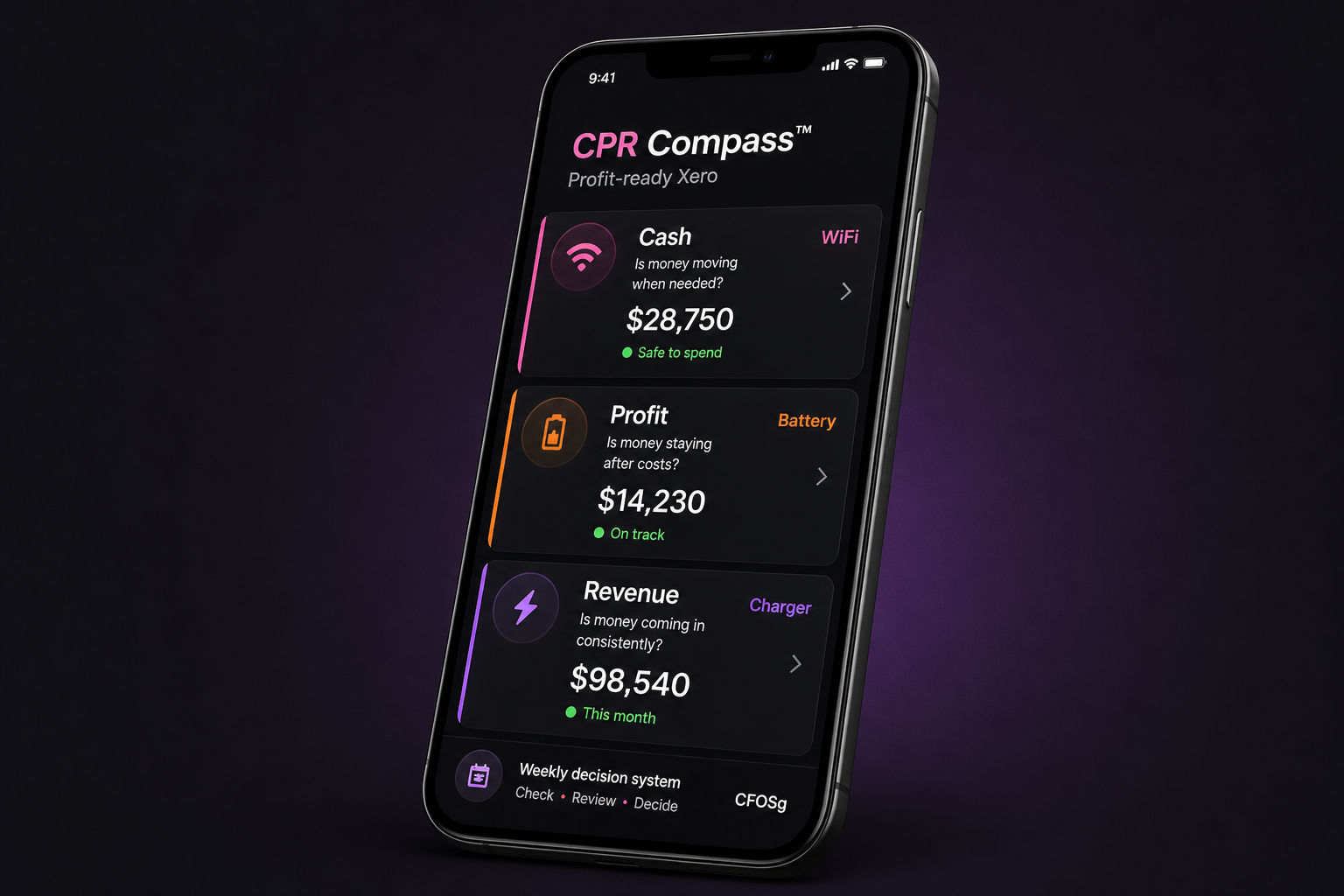
The CPR Compass™
A simple way to check whether your Xero is helping you make weekly money decisions.
Cash
What can I spend?
Profit
What should stay?
Revenue
What must come in?
Your Xero may not be profit-ready if...
- You still rely mainly on bank balance
- You do not know safe-to-spend cash
- You only check reports after month-end
- Profit feels unclear
- Sales look active but cash still feels tight
In the demo, we check what your Xero is not showing clearly.
We look for the gaps that make cash, profit and revenue decisions harder than they should be.
Cash
Safe-to-spend?
Profit
Protected?
Revenue
Enough coming in?
Stop guessing from your bank balance.
Turn Xero into a weekly decision system for cash, profit, and revenue.
Book your Profit-Ready Xero demoWhat Xero shows vs. what you still need to know
Xero can show what happened. But owners still need to know what to do next.
If your Xero shows reports but not clear decisions, it may not be profit-ready.
Book a Profit-Ready Xero demo and we will check what your Xero is not showing clearly.
Book a Profit-Ready Xero demo