
20-min Curiosity Call Script
0:00–0:30 | opener + promise
“Hey {{name}}, thanks for booking. This is a 20-minute curiosity call — not a sales interrogation.
My goal is simple: by the end of this call, you’ll leave with one clear next step you can do this week, even if you don’t work with me.”
0:30–2:00 | set the frame (so it stays tight)
“I’m going to ask a few quick questions, then I’ll tell you what I think the real issue is, and I’ll give you one move to test. Deal?”
2:00–5:00 | confirm their form answers (fast)
“I saw your answers:
revenue: {{their revenue range}}
what’s happening: {{their 1–2 selected problems}}
what you want most: {{their selected outcome}}
what you’ve tried: {{their selected tried}}
how soon: {{their timing}}
Did I get that right?”
(if they add more problems)
“Got it. I’m going to pick one to fix first, because fixing the first leak usually calms everything else down.”
5:00–8:00 | the 3-question diagnosis (CPR, but don’t say CPR)
“Quick diagnosis. Answer yes/no.”
“In the next 14 days, are you worried about paying anything on time — bills, payroll, GST, suppliers?”
“Do you consistently set aside any profit, or does it usually get used up?”
“Is sales steady enough that you feel calm, or does it feel unpredictable month to month?”
Then say:
“Based on that, your first bottleneck is [Cash / Profit / Revenue].”
8:00–15:00 | give them the “one move” (choose the matching path)
PATH A — if their first bottleneck is CASH
“Your issue isn’t ‘more reports’. It’s weekly spending uncertainty.
So here’s the one move for the next 7 days:
Pick a weekly spending (OpEx) limit.
Treat that number like a boundary — if it’s not inside the limit, it waits.
Let’s set a rough limit now:
What are your unavoidable weekly essentials? (payroll, rent, key bills)
What’s your average weekly inflow?”
(choose a simple line)
“Ok, for this week, your safe spending cap is about $X. Start there. We can refine later.”
close the path:
“If you do only this, you’ll stop the ‘surprise’ weeks immediately.”
PATH B — if their first bottleneck is PROFIT
“Your issue isn’t that you don’t make sales. It’s that profit doesn’t get protected.
So here’s the one move for the next 7 days:
Set up a separate bank account. Can be your personal bank account for now if its cumbersome to set up a corporate bank account immediately. Make sure its a ‘do not touch’ profit account.
Set aside a tiny % from new income — even 1% every month. It’s not about the amount, its the habit/consistency.
We’re not trying to get rich this week. We’re trying to prove the system works.”
(set it)
“Let’s pick the starter % right now: 1% or 3%?”
close the path:
“When profit has a place to go, it stops becoming the emergency fund.”
PATH C — if their first bottleneck is REVENUE
“Your issue isn’t motivation. It’s that revenue doesn’t cover the cost structure consistently.
So here’s the one move for the next 7 days:
Set a weekly sales target number.
If you’re below target mid-week, freeze non-urgent spending.
Let’s do the quick reality check:
Rough monthly fixed costs?
Rough gross margin?”
(give a simple target)
“Ok, your weekly ‘don’t-panic’ target is roughly $X. That’s the number to watch.”
close the path:
“This stops you from spending based on hope.”
15:00–18:00 | recap (make it feel like a win)
“Let me summarise your ‘one move’:
Your first bottleneck: [Cash/Profit/Revenue]
Your one move this week: [spending cap / profit set-aside / weekly target]
Your rule: [boundary rule]”
“Does that feel clear enough to actually do?”
18:00–20:00 | soft close (no pressure, but points to your paid solution)
“If you run this for 1–2 weeks, you’ll feel a difference.
If you want, the paid work is simply this: we build that rule into your Xero + bank setup so it becomes a weekly system you don’t have to think about.
If not, no worries — you already have the next step. Want me to send a quick summary after this call?”
(then)
“Anything else you want to ask before we wrap?”
after-call message
“Hey {{name}}, here’s your quick summary:
first bottleneck: [Cash/Profit/Revenue]
one move this week: [X]
rule to follow: [Y]
If you want help setting this up as a weekly system inside Xero, reply ‘system’ and I’ll share the next step.”
Totally fair. “Revenue help” sounds like boring marketing fluff.
What you want is a revenue path that feels like:
“stop the bleeding”
“stop guessing”
“stop chasing random sales”
Here are better, non-lame versions you can use in the call (and they still map to revenue).
rename the “revenue” bucket (say this on the call)
Instead of “revenue issue”, say:
this is a sales pace problem
this is a break-even gap
this is a predictability problem
this is a pricing + volume mismatch
this is a pipeline isn’t feeding the machine problem
the revenue script that doesn’t feel lame (8:00–15:00 path)
say:
“ok, this isn’t a ‘marketing problem’. this is a sales pace problem.
right now, you’re driving without a speedometer. so you spend based on vibes, then panic later.”
then give the one move:
“your one move this week is a weekly minimum sales number. not a goal. a survival line.”
quick questions (keep it fast):
quick questions (keep it fast):
“rough monthly operating expenses? ballpark.”
“rough gross margin? if you don’t know, tell me your typical cost for $100 of sales.”
then give the number:
“ok. your weekly minimum is about $x.
rule: if you’re under pace by mid-week, freeze optional spending until you catch up.”
close:
“this doesn’t magically create sales. it stops you from spending like you already have sales.”
if they hate numbers, use this version
“your one move is not ‘get more customers’. it’s ‘stop selling at a level that can’t carry the business.’
rule for 7 days: no discounts, no underpricing, no ‘busy work’ that doesn’t pay.”
what to call it in your tidycal + script (pick one)
sales pace check
break-even gap check
weekly target to stop guessing
stop-spending-until-you’re-on-pace rule
If you want, I’ll rewrite your whole 3-path section so the three buckets sound equally punchy:
cash = spending boundary
profit = profit protection rule
revenue = sales pace / break-even gap (not “revenue help”)
Is your Xero profit-ready?
Your Xero may be updated, reconciled, and still not helping you make better money decisions.
Check the 3 warning signs most business owners miss.
Is your Xero profit-ready?
Your Xero may be updated, reconciled, and still not helping you make better cash, profit, and revenue decisions.
Your bank balance can lie.
That money may already belong to bills, payroll, GST, tax, or supplier payments.
The money is there.
But it may not be safe to spend.
Updated accounts are good. Useful accounts are better.
Most businesses use Xero to record what happened. But owners need to know what to do next.
Can I spend?
Can I pay myself?
Do I need more sales?
You do not know your safe-to-spend cash.
You may see cash in the bank, but still not know how much is actually available after upcoming commitments.
This is where accidental overspending starts.
You do not know what profit to protect.
If profit is not protected first, expenses usually find a way to eat it.
Profit disappears quietly before owners notice.
You do not know your revenue floor.
More sales are not always the answer. You need to know the minimum revenue needed to cover costs and protect profit.
Busy sales can still create cash stress.
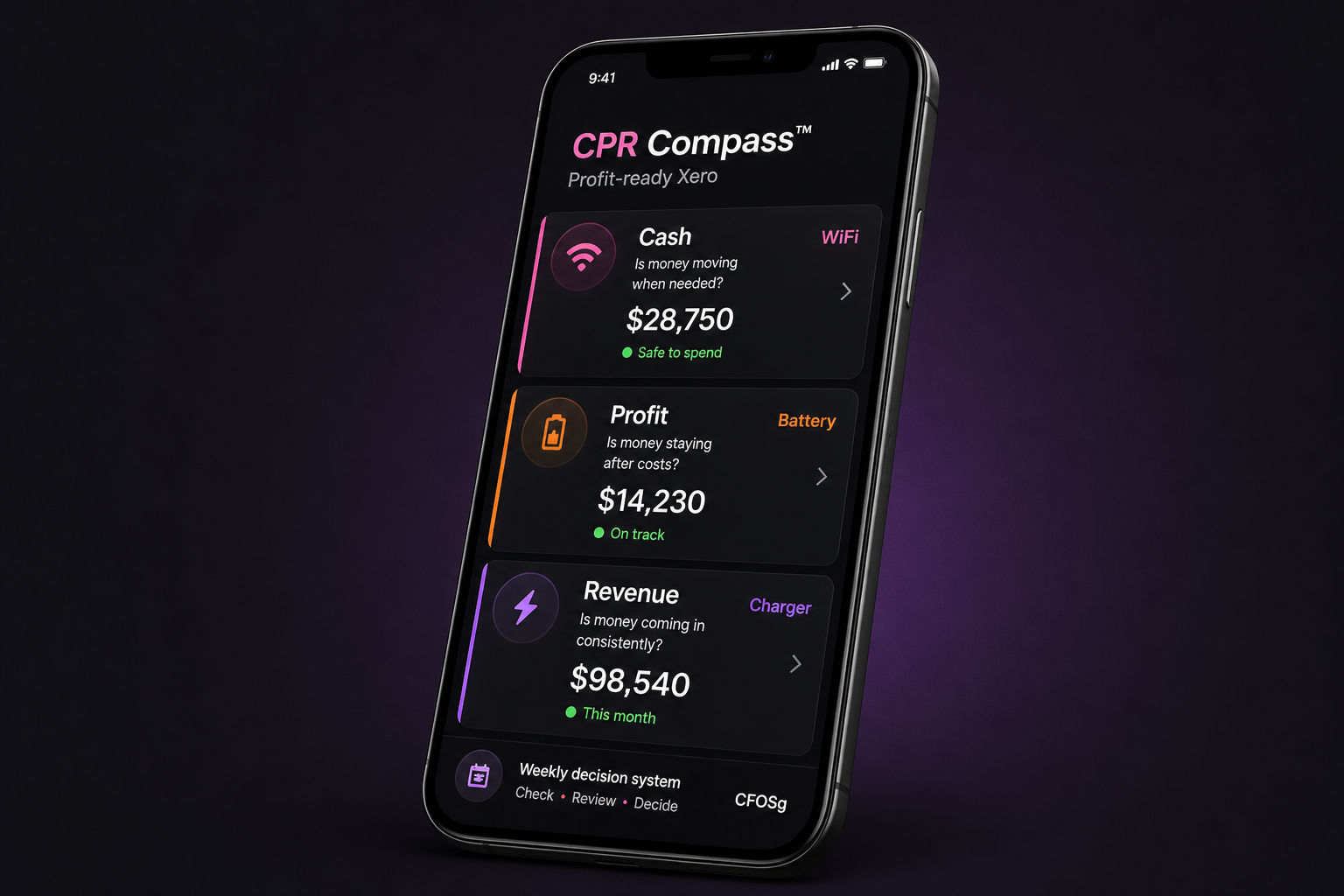
The CPR Compass™
A simple way to check whether your Xero is helping you make weekly money decisions.
Cash
What is safe to spend?
Profit
What should stay?
Revenue
What must come in?
Your Xero may not be profit-ready if...
- You still rely mainly on bank balance
- You do not know safe-to-spend cash
- You only check reports after month-end
- Profit feels unclear
- Sales look active but cash still feels tight
Want us to check your Xero?
Book a Profit-Ready Xero demo. We will look at what is unclear, what is missing, and what should be fixed first.
Book a Profit-Ready Xero demoStop guessing from your bank balance.
Turn Xero into a weekly decision system for cash, profit, and revenue.
Book your Profit-Ready Xero demoIs your Xero profit-ready?
Your Xero may be updated, reconciled, and still not helping you make better money decisions.
Check the 3 warning signs most business owners miss.
Is your Xero profit-ready?
Your Xero may be updated, reconciled, and still not helping you make better cash, profit, and revenue decisions.
Your bank balance can lie.
That money may already belong to bills, payroll, GST, tax, or supplier payments.
The money is there.
But it may not be safe to spend.
Updated accounts are good. Useful accounts are better.
Most businesses use Xero to record what happened. But owners need to know what to do next.
Can I spend?
Can I pay myself?
Do I need more sales?
You do not know your safe-to-spend cash.
You may see cash in the bank, but still not know how much is actually available after upcoming commitments.
This is where accidental overspending starts.
You do not know what profit to protect.
If profit is not protected first, expenses usually find a way to eat it.
Profit disappears quietly before owners notice.
You do not know your revenue floor.
More sales are not always the answer. You need to know the minimum revenue needed to cover costs and protect profit.
Busy sales can still create cash stress.
The CPR Compass™
A simple way to check whether your Xero is helping you make weekly money decisions.
Cash
What is safe to spend?
Profit
What should stay?
Revenue
What must come in?
Your Xero may not be profit-ready if...
- You still rely mainly on bank balance
- You do not know safe-to-spend cash
- You only check reports after month-end
- Profit feels unclear
- Sales look active but cash still feels tight
Want us to check your Xero?
Book a Profit-Ready Xero demo. We will look at what is unclear, what is missing, and what should be fixed first.
Book a Profit-Ready Xero demoStop guessing from your bank balance.
Turn Xero into a weekly decision system for cash, profit, and revenue.
Book your Profit-Ready Xero demo